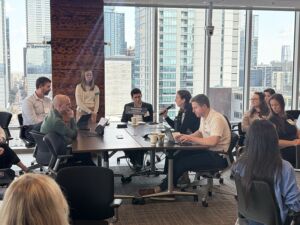
Sustainability professionals within real estate investment management are adjusting to a changed political and regulatory landscape, evolving industry nomenclature, and shifting market realities, attendees heard at NAREIM’s Sustainability meeting held in Austin this week.

“We have guardrails on terminology,” one participant said. “Banned terms include ‘climate change,’ ‘net zero,’ and ‘DEI+B.’ But we continue to do the work and call it something else, like ‘climate resiliency.’”
Others echoed the importance of continuing to push forward with the “good work,” and even accelerating it, given that investor pressure to do so hasn’t necessarily abated.
- To view meeting photos, access our Flickr album here.
“The center of gravity has shifted, but the work hasn’t stopped,” attendees heard.
One example of the staying power of sustainability efforts and societal-level support for it: the survival of the energy-efficiency program Energy Star in the face of pressure in Washington.
“Energy Star faced political fragility but industry support, including key trade groups pushing for it, kept the program alive,” shared a member.
What Investors Want: Reporting
Despite what one attendee described as the current “ESG antagonistic environment,” investor appetite for sustainability data has only intensified.
In fact, 95% of firms have experienced an uptick in both the volume and breadth of investor-driven questionnaires, ad hoc requests, and reporting requirements over the last two-to-three years.
“Investors are more sophisticated,” a member said. “They want data by fund, by strategy, by asset.”Each year seems to bring new additional reporting categories: modern slavery, biodiversity, explicit CRREM alignment and targets, and more, resulting in a growing burden on existing teams.
But 53% of participants are not increasing staff size to account for this demand growth.
Instead, 37% said their firms are opting to shift responsibilities to other functions, like compliance, legal, and operations/governance, while 57% said they are outsourcing responsibilities to consultants to build processes, plans, and gap analysis, specifically to meet requests regarding newer topics.
Legal teams have increasingly become important partners in these efforts.
NAREIM members also discussed the importance of internal coordination, including being better at proactively involving asset managers before an investor asks a question, and having portfolio managers “be in the room, copied on the email, and invited to the call.”
To be sure, participants meet the majority of new asks. But 56% said they are comfortable with “good enough,” imprecise responses for “many” or “the majority of” these new asks.
“We give a simple response. Then we let the investor follow up. The ones who actually care will follow up.”
Insurance Industry: A Sustainability ‘Accelerant’
While investors and regulatory frameworks have most often pushed forward progress on sustainability efforts, attendees at the meeting noted that a surprising driver today is coming from insurance carriers.
As climate-related risks intensify, insurers are pricing in these risks according to their own metrics, prompting asset owners to take action and communicate those actions back to the carriers, and hopefully reduce their premiums.
“It’s a conversation,” one member noted. “They are interested in our process.”
Insurers appreciate hearing about asset-level investments, such as winterization efforts, and they view
EV charging as a fire risk, rather than as an amenity and decarbonization tool.
Leveraging intermediaries, like Archipelago, the property-level risk information platform, has been useful in these discussions.
To access the full 2026 Sustainability Meeting takeaways and meeting resources, click here to login to the Info Hub.