
 NAREIM and Ferguson Partners (FP) have released findings from the 2026 Global Management Survey (GMS), the most comprehensive annual study of management practices in the real estate investment management and private equity industry.
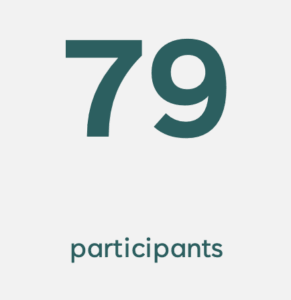
Now in its 18th year, the GMS draws on responses from 79 firms spanning a wide range of strategies, sizes, and geographies, providing industry leaders with benchmarks across capital raising, financial performance, organizational structure, staffing, and governance.
The Headline: Growth Is Steady. Margins Are Tight.
For the second consecutive year, the median firm reported positive net AUM growth — up 5% year over year — with two-thirds of same-store participants increasing net assets.
 Acquisition volumes rose across small and mid-size firms from 2024 to 2025, and optimism is building: 82% of all firms surveyed expect acquisition volumes to increase again in 2026.
Yet the growth story comes with a significant caveat. Expenses continue to outpace revenues for many firms, with 59% of respondents reporting year-over-year expense increases against only 46% reporting revenue growth.
As a result, the majority of respondents saw profitability decline in 2025, which is a trend the survey identifies as a defining challenge heading into the year ahead.
"The data paints a clear picture of an industry that is growing but working harder to protect its economics," said Michelle Yelaska, Vice President at Ferguson Partners. "For the second year in a row, the median firm expanded its AUM, yet expenses are rising faster than revenues across a majority of participants."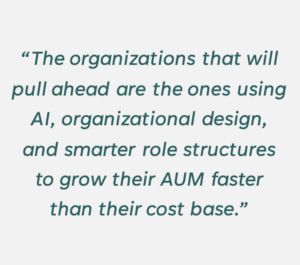
"This tells us that firms can no longer rely on revenue growth alone to solve the efficiency problem," Yelaska added. "The organizations that will pull ahead are the ones using AI, organizational design, and smarter role structures to grow their AUM faster than their cost base."
Three Organizational Imperatives Defining 2026
Against this financial backdrop, the 2026 GMS identifies three areas where leading firms are focusing their attention:
1. AI Is Moving Into the Investment Process — and Governance Must Keep Up
The use of AI and automation is shifting from back-office support toward core investment work. The share of firms prioritizing investment underwriting and modeling as an AI or automation focus area jumped from 8% to 29% year-over-year, the single largest movement in the survey's data.
Market research and data aggregation also surged, rising 16 percentage points. Meanwhile, 42% of firms now have a formal technology committee, though the majority of those bodies remain advisory-only without formal decision-making authority.
The survey flags this governance gap as increasingly consequential as AI moves closer to investment decisions.
2. Workloads Are Rising Faster Than Headcount
Median headcount growth was flat in 2025, with 48% of firms adding employees, 11% holding steady, and 41% reducing headcounts.
Yet workloads continued to climb: the median asset manager is now responsible for 16 properties, up from 13 in 2024, while NOI per asset manager rose from $28 million to $40 million over the same period.
With salary and benefit expenses accounting for 42% of revenues at the median, firms are increasingly focused on growing AUM faster than headcount.
This strategy, however, is only sustainable if work is organized to match the right tasks to the right people and tools. Looking ahead, 67% of firms expect to increase headcounts in 2026, signaling cautious optimism about the path forward.
3. Succession Planning Stops at the C-Suite
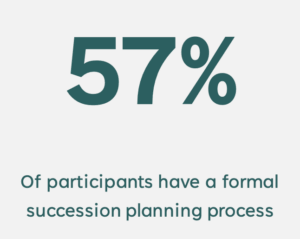
Fifty-seven percent of firms now have a formal succession planning process, but coverage is concentrated almost entirely at the senior leadership level.
Only 32% of firms offer formal development programs for mid-level professionals, despite this being precisely the cohort expected to absorb expanded portfolios and eventually fill senior roles.
The survey identifies this as an emerging operational risk, not merely a talent development gap.
"What we're seeing across the industry is a group of firms that have done the work to protect their senior leadership continuity, but haven't yet extended that discipline one level down," said Mike Cordingley, Managing Director at Ferguson Partners. "Mid-level professionals are already carrying larger portfolios and being asked to produce more with less support, and yet only about a third of firms are investing in their formal development. That is now an operational risk."
"The firms that recognize this now and build intentional development pathways for that layer of the organization will be better positioned when leadership transitions happen," Cordingley added.
About the Survey
The 2026 GMS Executive Summary is available to all NAREIM members and industry stakeholders. The full participant report of findings, which includes detailed benchmarking data across financial performance, capital raising, staffing, workload metrics, organizational structure, and governance is available exclusively to survey participants.
To learn more or inquire about participation in next year's survey, contact Michelle Yelaska.