
Generative AI is already reshaping how real estate investment management firms operate. Those that move decisively are likely to gain a competitive advantage, attendees heard last week during NAREIM’s Virtual Exchange Series: Technology, Data & AI Survey Analysis.
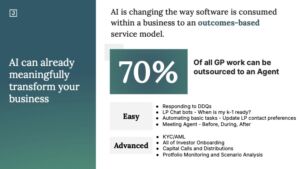
“Seventy percent of what GPs do can be outsourced to technology, maybe even 80%.”
One analogy resonated throughout the discussion: the transition from steam-powered to electricity-powered factories more than a century ago. When electricity first arrived, many manufacturers attempted to retrofit existing steam-engine factories to use the new power source.
The companies that won were those willing to invest the capital to build factories designed for electricity from inception. The same dynamic may emerge in real estate investment management.
“AI-native firms” built around generative AI technology from day one could gain an advantage over competitors trying to adapt legacy processes, attendees heard.
Yet established firms possess something newcomers will struggle to replicate: the trust of their investors, which they have spent years nurturing.
“AI-native firms that will compete the best will be those that pull people together from legacy firms, so they have that incumbent trust that's there, but they are going to be rebuilding that factory from scratch.”
Avoid Expensive AI Consultants Unfamiliar with Real Estate
The discussion challenged a common assumption about AI implementation. Rather than recruiting expensive outside AI specialists with limited understanding of real estate investment management, firms were encouraged to focus first on the expertise already inside their organizations.
“You should use your existing staff, not hire expensive people who don’t understand the problem you are trying to solve.”
The people who understand the business–including, and possibly especially, individual contributors–are often best positioned to identify where AI can create value.
The notion that AI is primarily a cost-cutting tool is misguided, and it’s a critical misconception that leaders should address carefully.
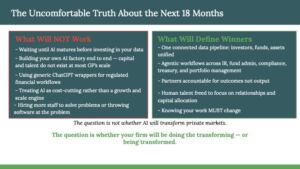 Rather than replacing employees, AI is likely to make professionals dramatically more effective, perhaps 10x, allowing them to focus on higher-value work. Firms that frame adoption as a tool for empowerment rather than elimination may find less resistance and stronger engagement.
At many firms, junior employees and individual contributors are already using AI extensively to improve their workflows–and often in their personal lives. Senior leadership teams, meanwhile, are often unaware of how these tools are being applied in practice.
“Identify the people already using AI successfully and learn from them.”
Those early adopters can become internal champions, helping spread knowledge across departments and turning isolated “productivity hacks” into scalable processes.
“Employees are three times more likely to be using AI to do their job than the management realizes,” participants heard. “People want to use AI. They want to make their jobs easier. But they are constrained from a governance standpoint.”
Accuracy in Focus
Still, every AI-generated result requires human review.
“Your goal is to create agents and then just review the output.”
Maintaining a human service layer–and keeping humans in the loop to validate outputs– remains a key ingredient of successful AI implementation.
“Trust but verify. Make the agent show its work.”
Participants heard that familiar workflows and even tools such as Excel could become less central as AI-powered interfaces gain prominence. One reason is that AI is increasingly effective at identifying and correcting data-quality issues.
“You can give it thousands of documents that are unstructured and say, ‘please organize for me’ and it will get it 95% accurate,” attendees heard. “Have AI check your data quality.”
Rethinking Jobs, Rethinking Careers
Investment managers should expect their daily responsibilities to change.
“You will need to relearn your job. You will need to rethink what your job should be.”
That’s a cultural challenge–one senior leaders will need to actively champion. The road to successful AI adoption runs through a willingness to take risks and show vulnerability at a personal level, regardless of seniority.
“Be willing to embarrass yourself to foster a culture of experimentation. That’s how we all learn.”
To access the full 2026 Virtual Exchange Series: Technology, Data & AI Survey Meeting takeaways and meeting resources, click here to login to the Info Hub.